Dental Insurance Verification Checklist: What to Verify Before a Patient’s Appointment
Use this dental insurance verification checklist to review eligibility, benefits, deductibles, limits, exclusions, and more before patient appointments.
Practical guides on insurance verification, payment posting, claims management, and AI automation — written by the Dentistry Automation team.

Use this dental insurance verification checklist to review eligibility, benefits, deductibles, limits, exclusions, and more before patient appointments.

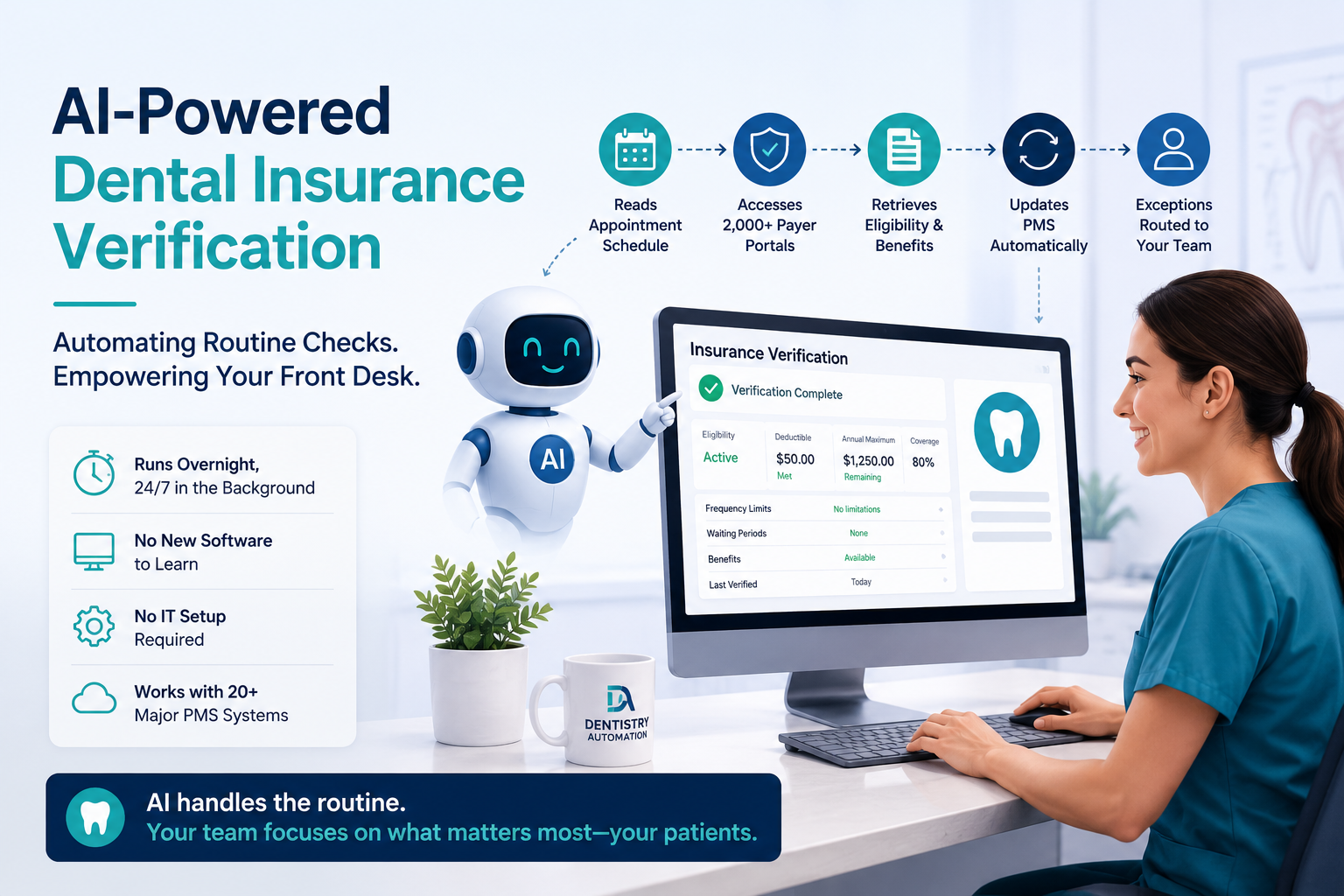
See how AI-powered dental insurance verification automates routine benefit retrieval, PMS updates, and exception routing while keeping staff oversight.

Compare manual, outsourced, and AI-automated dental payment posting. Cost analysis, accuracy rates, scalability limits, and a decision framework for practices and DSOs.

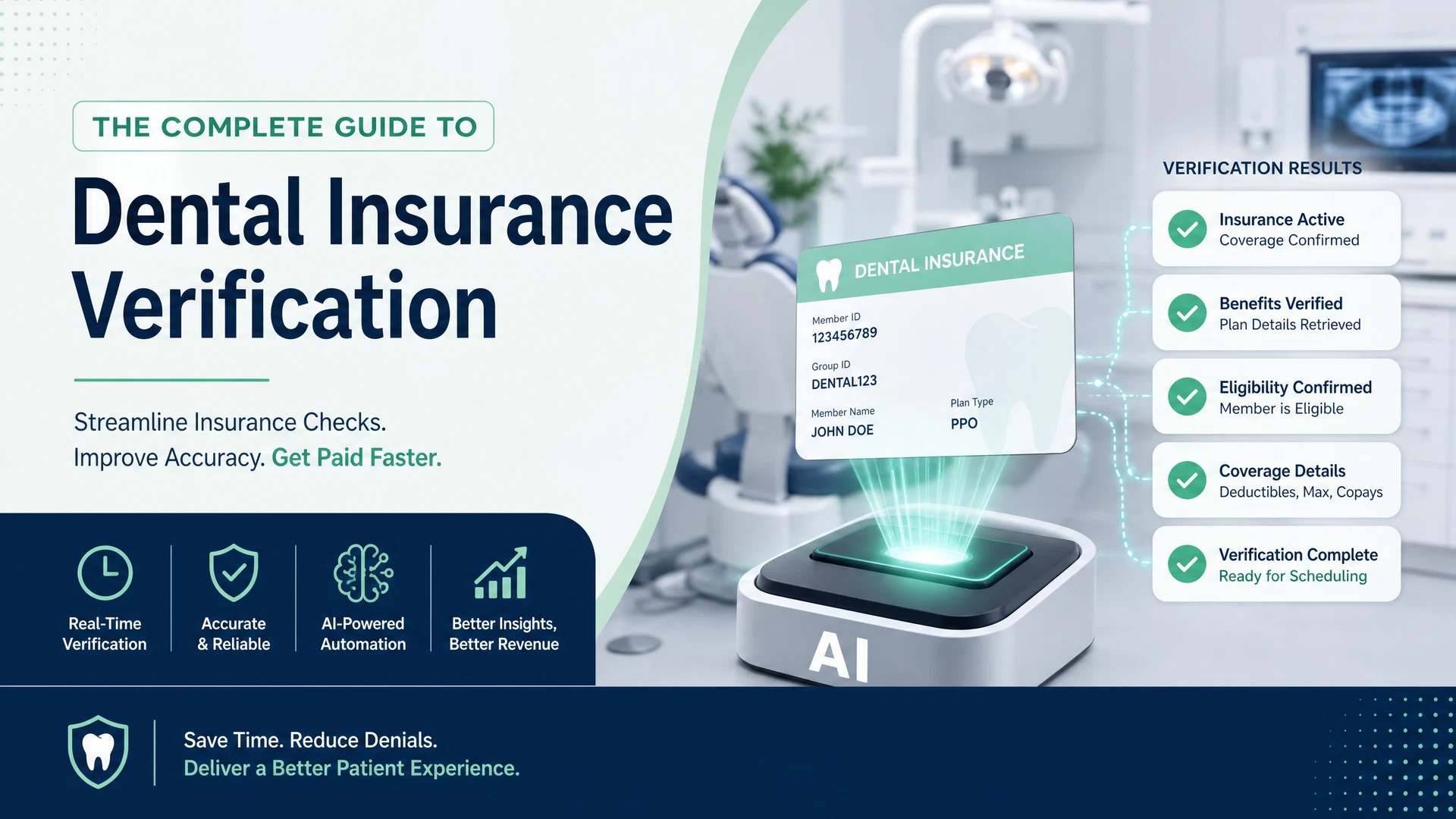
Master dental insurance verification with this comprehensive 10-step guide. Reduce claim denials, improve accuracy, and learn how AI automation transforms the process.

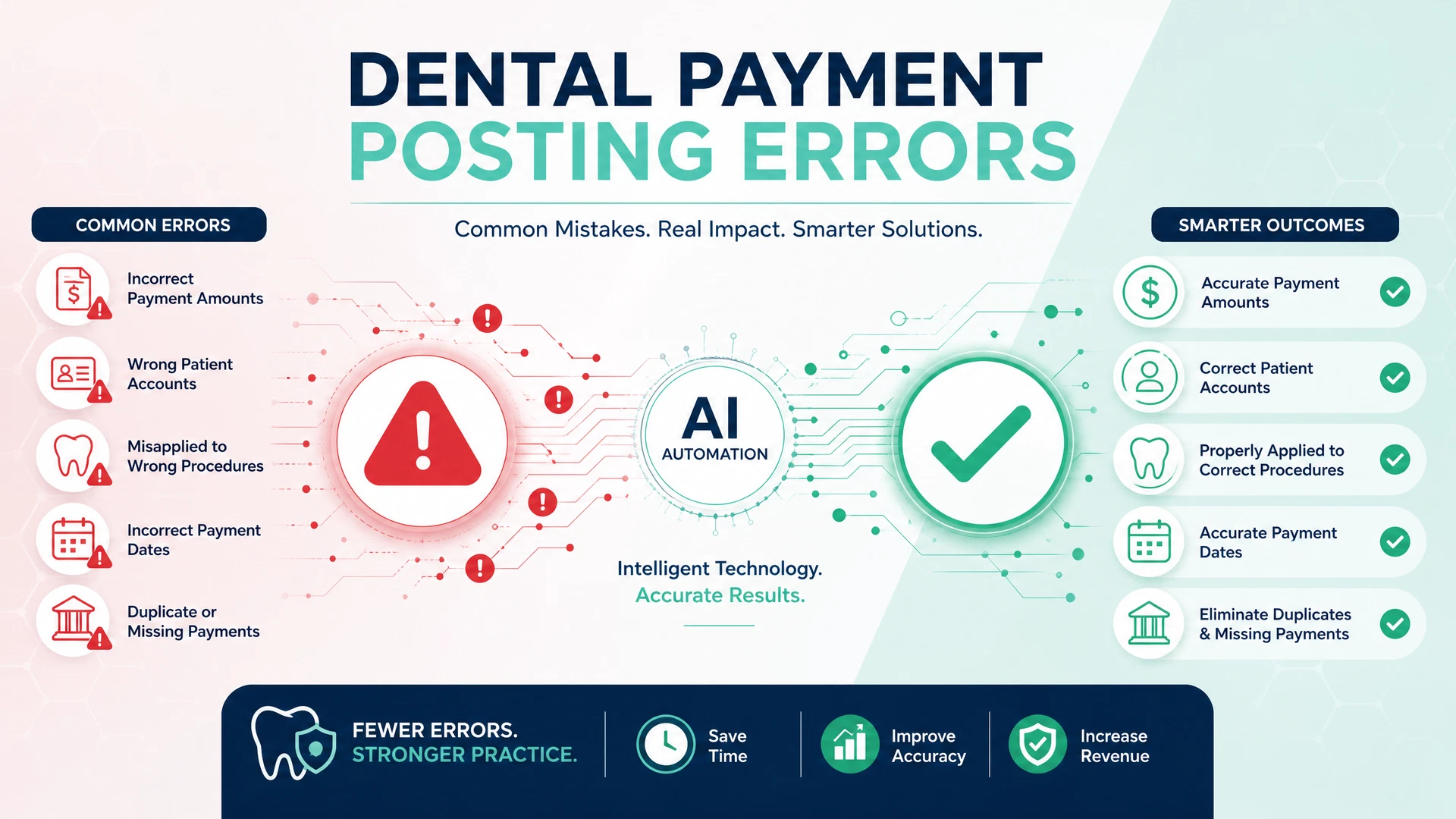
Discover the 10 most costly dental payment posting errors and how AI-powered automation prevents each one. Includes financial impact analysis and prevention strategies.

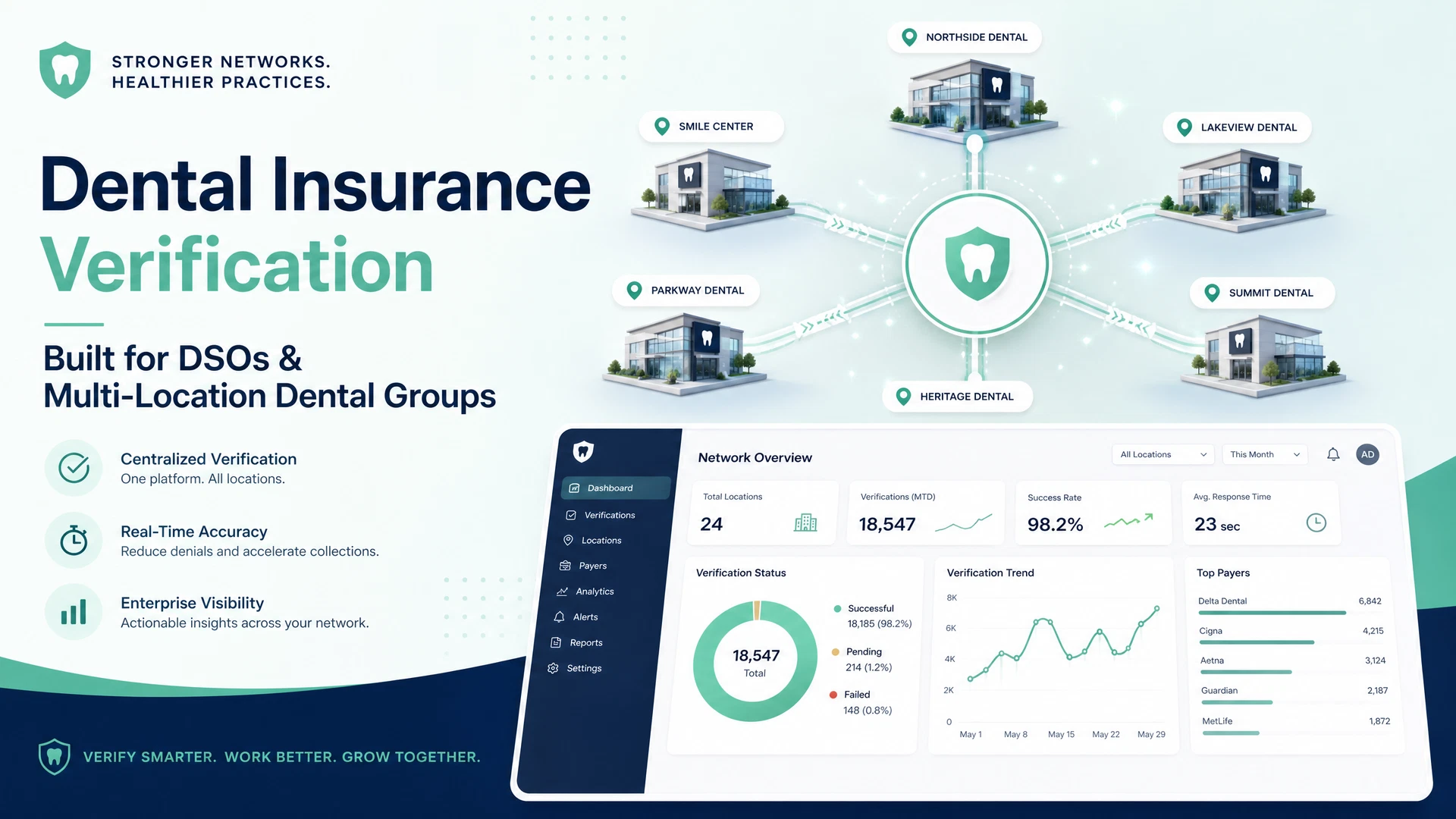
Operational playbook for DSOs scaling insurance verification across multiple locations. Three models compared with implementation timeline and KPI targets.

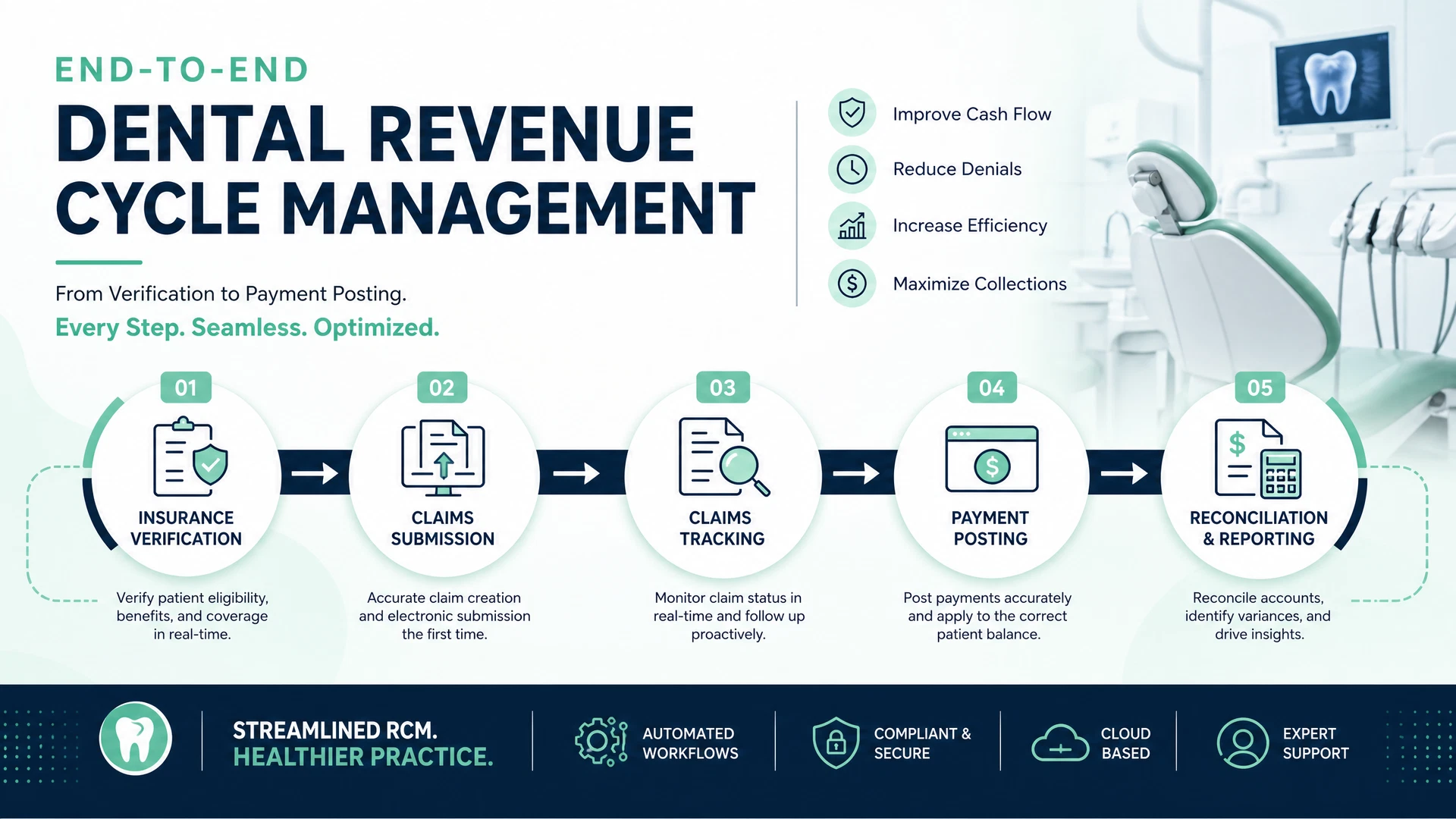
Map the complete dental revenue cycle from insurance verification through payment posting. Identify where breakdowns occur and how integrated automation eliminates gaps.

Understand what dental payment posting means, why it matters for your revenue cycle, and how it differs from payment processing. A foundational guide for dental billing teams.

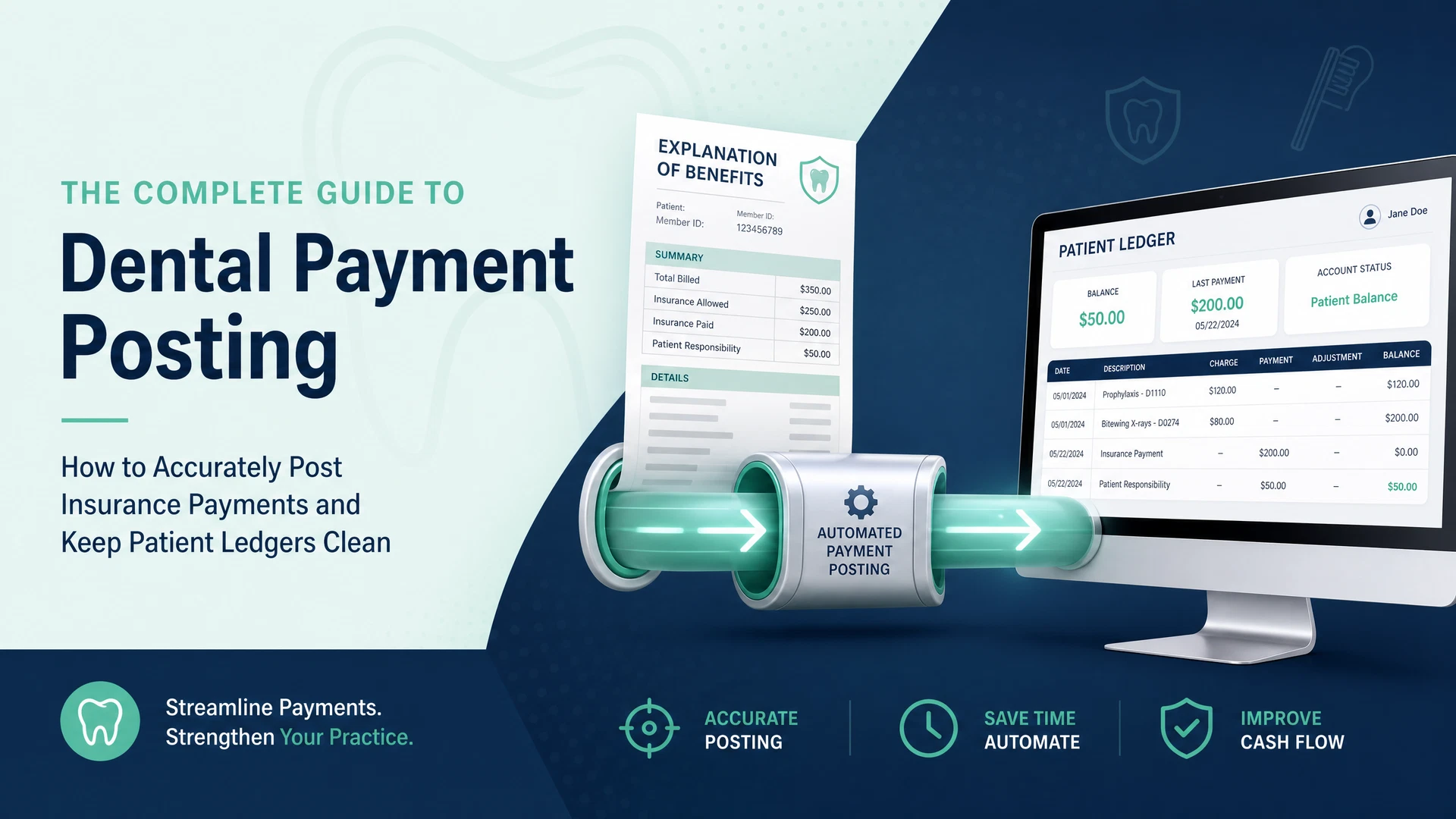
Learn the exact step-by-step process for posting dental insurance payments correctly, from reading the EOB to updating the patient ledger in your PMS.

Discover why posting dental payments by procedure instead of lump sum is critical for accurate provider compensation, fee schedule maintenance, and clean ledgers.

See exactly how automated dental payment posting works — from ERA ingestion to intelligent matching to PMS write-back — and why 98% of payments can post without human touch.

Should you outsource dental payment posting? Compare costs, quality, control, and scalability of outsourced billing services versus in-house and automated alternatives.

Understand how Electronic Remittance Advice (ERA/835) files work in dental billing, how they connect to EFT deposits, and how to post them accurately.

Learn the critical differences between paper EOBs and electronic ERAs, how each is processed, and why practices should transition to electronic remittance.

Master payment posting in Dentrix with these proven best practices. Avoid the most common mistakes that corrupt ledgers and create billing confusion.

A comprehensive guide to payment posting in Open Dental, covering ERA auto-posting, manual entry, adjustment codes, and reconciliation best practices.

Speed up payment posting in Patterson Eaglesoft with these tips for batch processing, adjustment handling, and avoiding common posting errors.

Learn the three-way reconciliation process that ensures your posted payments match ERA totals and bank deposits. Catch discrepancies before they become problems.

Understand the different types of dental adjustments — contractual write-offs, deductibles, co-insurance — and how to post each one correctly in your PMS.

What does a dental payment poster do? Explore the skills required, daily responsibilities, salary expectations, and career growth opportunities in dental billing.

Create an effective payment posting training program for new dental billing staff. Covers EOB reading, adjustment codes, PMS navigation, and quality checks.

Track these 7 payment posting KPIs to measure speed, accuracy, and efficiency. Includes benchmarks for posting lag, error rates, and reconciliation gaps.

Discover why same-day payment posting dramatically improves cash flow visibility, aging report accuracy, and denial recovery rates for dental practices.

Use this 12-step dental payment posting checklist to ensure every payment is posted accurately, adjustments are correct, and reconciliation is complete.

Insurance underpayments cost dental practices $30,000-$50,000 annually. Learn how to systematically detect and recover underpaid claims during payment posting.

Learn the correct way to post dental claim denials, track denial patterns, and build an effective appeal workflow that recovers lost revenue.

Master the complex world of dual insurance dental posting. Learn COB rules, how to calculate secondary payments, and avoid false credits on patient ledgers.

Compare the top 7 dental payment posting software solutions of 2026. Features, pricing, PMS compatibility, and automation capabilities reviewed side by side.

Identify the root causes of payment posting backlogs in dental practices and implement proven solutions to eliminate delays and maintain current ledgers.

Should multi-location dental practices centralize payment posting or keep it distributed? Compare both models with cost analysis and operational considerations.

A data-driven comparison of AI-powered versus human dental payment posting across accuracy rates, processing speed, cost per transaction, and scalability.

Conduct a thorough audit of your dental payment posting process to identify errors, inefficiencies, and revenue leakage. Includes audit checklist and benchmarks.

A complete explanation of dental insurance verification — what it is, why it matters, who does it, and how it protects your practice from claim denials and revenue loss.

Compare verification timelines: 15-30 minutes manual vs. 30 seconds automated. Learn what factors affect verification speed and how to eliminate bottlenecks.

Compare the leading dental insurance verification companies and platforms of 2026. Services, pricing, accuracy, and technology capabilities reviewed.

A buyer's guide to dental insurance verification software. Key features, integration requirements, pricing models, and questions to ask vendors before purchasing.

See exactly how AI-powered dental insurance verification works — from portal access to benefit extraction to PMS write-back — all without staff involvement.

Download a professional dental insurance verification form template and learn best practices for documenting verified benefits in your practice management system.

Avoid these 7 common dental insurance verification mistakes that lead directly to claim denials. Each mistake explained with prevention strategies.

The complete workflow for verifying dental insurance for new patients — from initial information collection to benefit documentation and patient communication.

Learn the optimal frequency for dental insurance verification. When to re-verify, what triggers a new check, and how to avoid stale benefit information.

Data shows that 30% of dental claim denials stem from verification failures. Understand the direct connection and how thorough verification prevents revenue loss.

Should you outsource dental insurance verification? Evaluate costs, quality, turnaround time, and integration requirements to make the right decision for your practice.

Optimize dental insurance verification in Dentrix with these workflow tips, integration options, and best practices for recording verified benefits.

A complete guide to managing dental insurance verification in Open Dental, including electronic eligibility, benefit documentation, and automation options.

Navigate the maze of dental insurance payer portals efficiently. Tips for faster login, benefit extraction, and avoiding common portal frustrations.

Calculate the ROI of improving your dental insurance verification process. Includes formulas for time savings, denial reduction, and revenue impact.

Understand dental insurance waiting periods, how to verify them during eligibility checks, and how to communicate coverage limitations to patients effectively.

Learn how to batch-verify dental insurance for your entire weekly schedule in advance, eliminating day-of scrambles and ensuring every patient is verified before arrival.

A complete guide to dental insurance pre-authorization — which procedures require it, how to submit requests, expected timelines, and what to do when denied.

Ensure your dental insurance verification process is HIPAA compliant. Covers data handling, third-party access, documentation requirements, and staff training.

Best practices for tracking dental insurance annual maximums and deductibles throughout the benefit year. Prevent over-treatment and surprise patient bills.

Learn effective strategies for communicating dental insurance verification results to patients, setting financial expectations, and improving treatment acceptance.

Strategies for managing dental insurance verification in high-volume practices seeing 50+ patients daily. Workflow optimization, staffing models, and automation.

Compare clearinghouse-based and portal-based dental insurance verification. Understand when to use each approach and how they differ in accuracy and speed.

Help patients maximize remaining dental benefits before year-end reset. Verification strategies for Q4 that boost production and patient satisfaction.

Identify the top 10 reasons dental claims get denied and implement proven prevention strategies for each. Reduce your denial rate from 15% to under 5%.

Master your dental claims aging report. Learn how to prioritize follow-up, identify patterns, and prevent claims from aging past the point of recovery.

Best practices for dental claim follow-up — optimal timing, effective scripts, escalation paths, and documentation requirements for successful resolution.

Learn how to submit clean dental claims that pass payer edits on the first attempt. Covers coding accuracy, documentation requirements, and pre-submission checks.

Write effective dental claim appeal letters that overturn denials. Includes templates, required documentation, and strategies for different denial types.

Discover how automated dental claims tracking uses AI to monitor every submitted claim, flag aging issues, and initiate follow-up before revenue is lost.

Compare your dental claim denial rate against industry benchmarks. Learn what top-performing practices achieve and how to close the gap.

Compare the leading dental claims tracking software solutions. Features, automation capabilities, PMS integration, and pricing reviewed for 2026.

Implement dental claim scrubbing to catch coding errors, missing information, and payer-specific requirements before claims are submitted. Reduce rejections dramatically.

Master the workflow for filing dental secondary insurance claims. Timing, coordination of benefits, documentation requirements, and common pitfalls explained.

Know the timely filing deadlines for every major dental insurance payer. Missing these windows means permanent revenue loss with no appeal option.

Understand dental downcoding — when insurers pay for a lesser procedure than what was performed. Learn how to document, appeal, and prevent systematic downcoding.

Know when dental claims require narratives, how to write effective clinical justifications, and which procedures most commonly need supporting documentation.

Understand the difference between dental predetermination and pre-authorization. When to use each, processing timelines, and impact on claim outcomes.

Know which dental claims require attachments, what documentation to include, proper formatting, and how electronic attachments speed up processing.

A comprehensive guide to dental revenue cycle management for DSOs. Covers centralization strategies, technology selection, KPIs, and scaling best practices.

Build an effective centralized billing operation for your DSO. Staffing models, technology requirements, change management, and performance benchmarks.

Should your DSO standardize on a single PMS or integrate multiple systems? Compare both approaches with real-world examples and decision frameworks.

Build a DSO executive dashboard with the revenue cycle KPIs that matter most. Includes benchmarks, visualization best practices, and action thresholds.

Integrate newly acquired dental practices into your DSO's revenue cycle within 90 days. Covers PMS migration, payer credentialing, and workflow standardization.

Combat the 35-45% annual turnover rate in dental billing with proven retention strategies. Compensation, career paths, technology, and culture approaches for DSOs.

Reduce days in A/R across your entire DSO portfolio. Centralized follow-up strategies, aging bucket management, and automation approaches that scale.

Negotiate better dental payer contracts using your DSO's volume as leverage. Preparation strategies, negotiation tactics, and fee schedule analysis techniques.

Prepare your DSO for dental billing compliance audits. Documentation requirements, common audit triggers, and remediation strategies for multi-location organizations.

Standardize patient billing and collections across your DSO. Statement design, payment plan policies, and collection workflows that maintain patient relationships.

Manage dental provider credentialing across a growing DSO. Centralized tracking, timeline management, and preventing revenue gaps during the enrollment process.

Build the optimal technology stack for DSO revenue cycle management. PMS, clearinghouse, verification, posting, analytics, and integration layer recommendations.

Set up revenue cycle management for a de novo dental practice within a DSO. Credentialing timelines, fee schedule configuration, and workflow establishment.

Transform raw RCM data into actionable insights for your DSO. Report design, KPI visualization, anomaly detection, and executive communication strategies.

Evaluate, select, and manage RCM technology vendors for your DSO. RFP templates, evaluation criteria, contract negotiation, and performance monitoring.

A complete explanation of dental revenue cycle management (RCM) — what it includes, why it matters, and how modern practices optimize each stage for maximum collections.

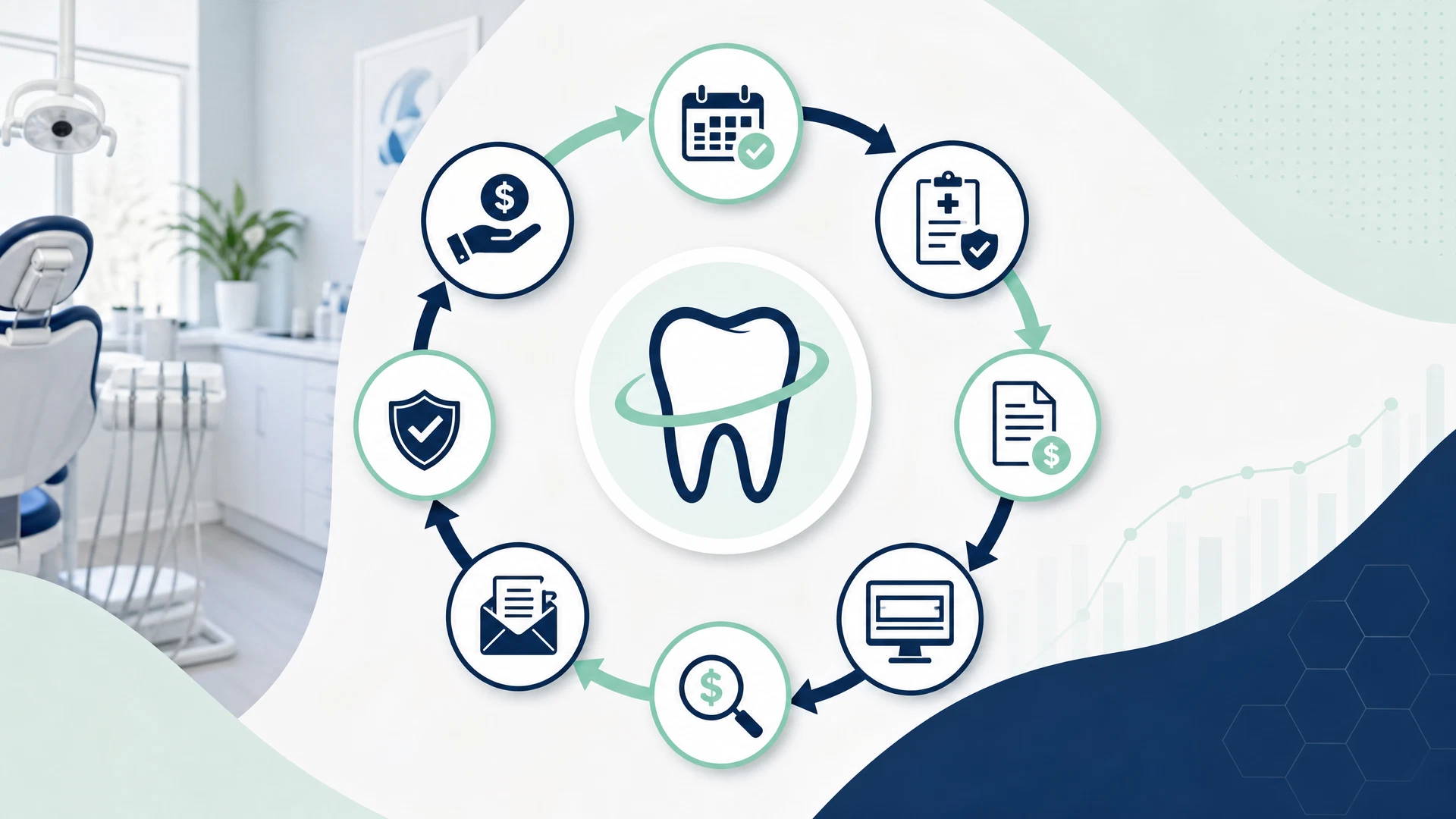
Visualize the complete dental RCM workflow in 7 stages — from patient scheduling through final payment collection. Identify bottlenecks and optimization opportunities.

Understand which dental RCM tasks can be fully automated, which benefit from AI assistance, and which still require human judgment. A practical automation roadmap.

Compare outsourced and in-house dental RCM models. Cost analysis, quality control, scalability, and hybrid approaches for practices of all sizes.

Compare your dental practice's RCM performance against 2026 industry benchmarks. Collection rates, denial rates, days in A/R, and cost-to-collect standards.

Identify the 8 most common sources of dental revenue leakage. From missed charges to uncollected copays to undetected underpayments — and how to plug each gap.

Quantify the true cost of dental billing errors beyond the obvious. Staff time, patient attrition, opportunity cost, and compound effects on practice revenue.

Define clear RCM responsibilities for your dental front desk team. Insurance verification, copay collection, scheduling optimization, and patient communication roles.

Explore the latest dental RCM technology trends for 2026. AI-powered automation, predictive analytics, real-time eligibility, and the future of dental billing.

Implement these 12 proven strategies to improve your dental collections rate. From verification improvements to patient communication to automation adoption.

Master dental accounts receivable management. Aging bucket strategies, follow-up workflows, write-off decisions, and benchmarks for healthy A/R.

Optimize your dental billing workflow from end to end. Identify bottlenecks, implement parallel processing, and create accountability at every stage.

Improve dental patient billing with clear statements, proactive communication, flexible payment options, and automated follow-up that maintains relationships.

Manage dental fee schedules effectively. UCR analysis, payer contract alignment, annual update strategies, and how fee schedules impact payment posting accuracy.

Improve dental coding accuracy to maximize insurance reimbursement. Common coding errors, CDT code updates for 2026, and documentation requirements by procedure.

Determine the right dental RCM staffing level for your practice. Formulas based on claim volume, provider count, and automation level. Avoid over- and under-staffing.

Understand your dental practice's cost-to-collect ratio. Industry benchmarks, calculation methods, and strategies to reduce collection costs without sacrificing revenue.

Develop a clear dental write-off policy. Decision criteria, documentation requirements, tax implications, and how to minimize write-offs through better upstream processes.

Solo dental practitioners can achieve excellent RCM results without dedicated billing staff. Technology, workflow, and outsourcing strategies for one-provider practices.

Plan a realistic dental RCM transformation. Phase-by-phase timeline covering assessment, technology selection, implementation, training, and optimization.

Discover why growing dental practices struggle with payment posting and how modern automation helps eliminate administrative bottlenecks without changing existing workflows.

Dental teams aren’t resisting innovation — they’re busy. After two decades in dentistry, Dr. Jasmine Sethi explores why the best automation is invisible and why technology should adapt to the practice, not the other way around.

Dental payment posting is often treated as a routine back-office task. But in reality, it's a multi-step process where small errors compound into significant revenue leakage. Learn how automation eliminates the most common failure points.
Claim denials remain one of the most frustrating and expensive challenges for dental practices and DSOs. While many factors contribute to denials, insurance verification errors are among the most preventable.

As Dental Service Organizations grow, operational complexity grows with them. Higher claim volumes, multiple locations, different PMS systems — manual payment posting simply doesn't scale.

Dental insurance verification is no longer a routine front-desk task — it is a critical operational function that directly impacts revenue, patient satisfaction, and claim approval rates.

Even the most experienced billing teams struggle with payment posting accuracy. With multiple payers, varying EOB formats, and complex contractual adjustments, errors are almost inevitable — unless you automate.

Payment posting is one of the most critical — and most overlooked — parts of the dental revenue cycle. Automation doesn't just save time; it fundamentally improves the accuracy and speed of your collections.

Insurance verification is one of the most time-consuming tasks in a dental office. Between logging into payer portals, cross-referencing benefit details, and updating the PMS, a single verification can take 20–40 minutes.

In today's dental world, data is everywhere but insights are nowhere. Most DSOs and group practices sit on a goldmine of operational data trapped inside disconnected PMS systems.

Marketing in dentistry isn't just about having a website or running occasional ads. Today's patients have endless options and high expectations. Here are the 7 most common marketing mistakes — and how to fix each one.

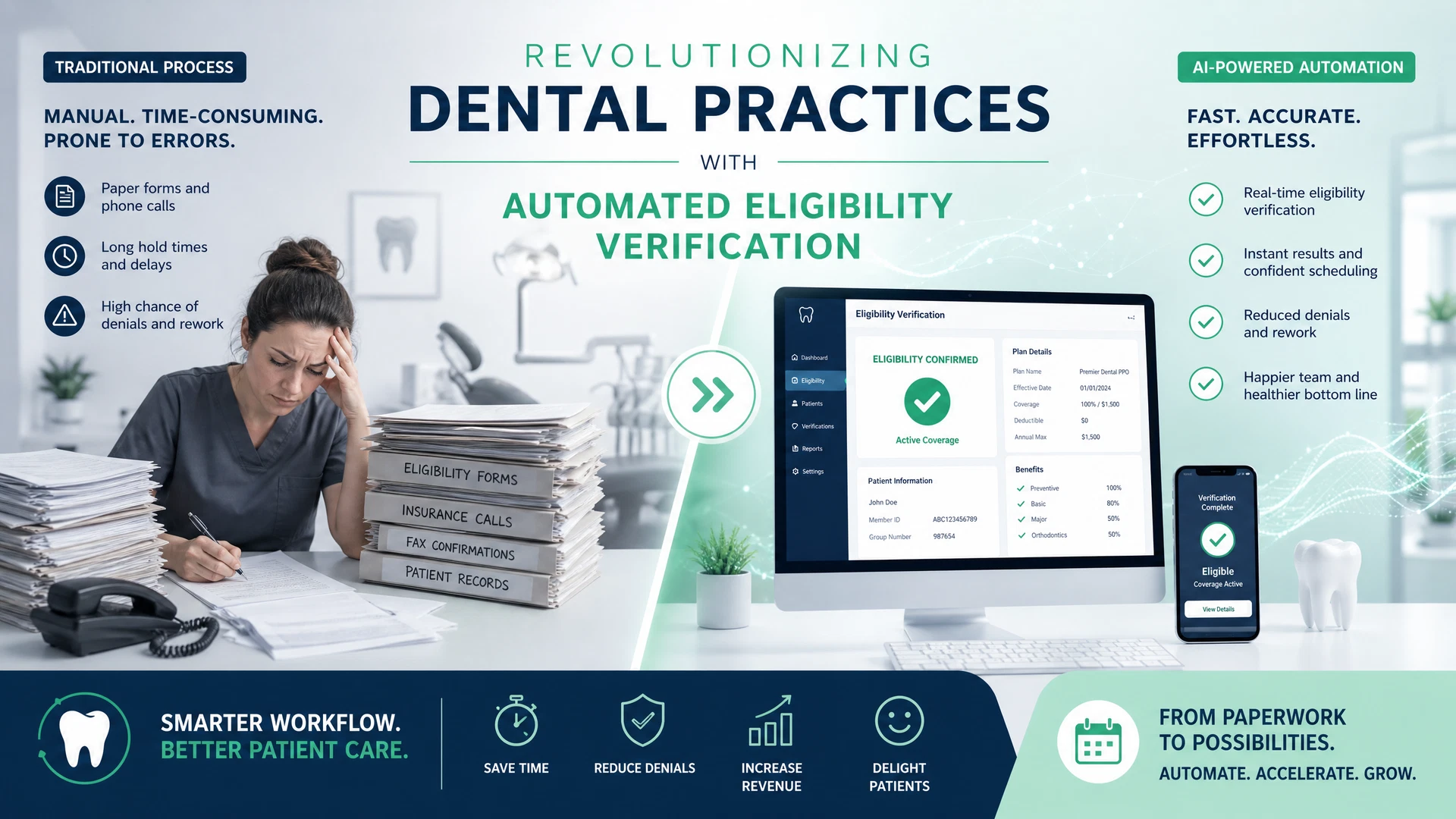
In the fast-paced world of dental care, efficiency and accuracy are critical. Dental practices across the globe are discovering that automated eligibility verification isn't just a nice-to-have — it's a competitive necessity.

Dental practices and DSOs rely on Practice Management Systems (PMS) to manage their operations. But when each location uses a different PMS, data becomes fragmented and insights become impossible.

You don't need 200 new patients a month. You need 10 who are ready to say yes to high-value treatment. Here's how to attract implant and Invisalign patients specifically.

In today's data-driven dental industry, DSOs and group practices are under pressure to scale fast, optimize workflows, and make data-driven decisions. A scalable dental data stack starts with the right API.

Most dental practices spend their days packed with hygiene appointments and cleanings — but those services barely scratch the surface of what your practice can offer.

In dental billing, delayed claims aren't just annoying — they threaten your cash flow and damage the patient relationship. AI agents are changing how practices follow up on claims.

Insurance verification is one of the bottlenecks you've normalized. For most dental teams, it's 'just part of the job.' But the hidden cost — in time, errors, and lost revenue — is enormous.

Dental claims don't follow themselves. Once a claim is submitted, someone on your team needs to check its status, follow up on aging buckets, and chase denials. AI agents do all of this automatically.

Manual payment posting is one of the most tedious (and expensive) parts of the dental revenue cycle. AI agents read EOBs, match payments, and post them automatically — no data entry required.

Insurance verification is still stuck in the 2000s for most dental practices. Logging into portals, calling insurance companies, waiting on hold — AI agents eliminate all of it.

Scaling a DSO shouldn't require an IT department. AI-powered data integration is replacing the need for custom IT vendors and expensive integrations.

If your operations team still relies on manual PMS exports, you're running your DSO on yesterday's data. AI agents extract, standardize, and deliver PMS data automatically.

Every DSO and growing dental group eventually hits the same integration wall. DentalBridge API solves the PMS integration problem that no one talks about.

The dental industry is evolving rapidly, and insurance verification is no exception. As technology advances, manual processes are being replaced by AI-powered automation.

Dental insurance verification is essential but often time-consuming and error-prone. Automated verification changes the equation entirely.

Insurance eligibility verification is a crucial part of a dental practice's revenue cycle. Delayed or inaccurate insurance information leads to claim denials, patient confusion, and revenue loss.

Dental insurance verification is a critical step in ensuring timely payments, accurate billing, and a seamless patient experience. Here's how to streamline it.

Verification of Insurance Benefits (VOIB) is a critical step in dental insurance verification. Without accurate benefit verification, practices face claim denials and revenue loss.

For many dental practices, insurance eligibility verification is a necessary but time-consuming process. Practices that rely on manual verification are losing hours and dollars every day.

Dental insurance verification is one of the most crucial yet time-consuming tasks for dental practices. This comprehensive guide covers everything from the basics to automation.

The dental industry is undergoing a digital transformation. At the center of this change is the rise of dental APIs — enabling DSOs to connect, extract, and act on PMS data at scale.

Revenue per provider, collection rate, claim denial rate, AR days — these are the KPIs that separate thriving DSOs from struggling ones. Here are the top 10 you must track.

Every dental practice and DSO generates vast amounts of data daily. The challenge isn't collecting data — it's extracting the KPIs that actually drive decisions.

Managing multiple Practice Management Systems across different locations is one of the biggest operational challenges for DSOs. Dental APIs make PMS integration seamless.

Tired of chasing insurance companies, spending hours on eligibility checks, and still losing revenue? AI-powered insurance verification is saving practices over $100K annually.

In multi-location dental organizations, a tight RCM process is the difference between thriving and just surviving. Here are the most common RCM workflow mistakes and how to fix them.

Manual EOB posting is one of the slowest, most error-prone parts of dental revenue cycle management. This guide shows you how to automate it completely.

Precision and streamlined operations aren't just nice-to-haves in dentistry — they're the backbone of every successful practice. AI-driven automation is revolutionizing how insurance verification works.

Verifying dental insurance is a crucial yet complex process for dental practices. Here are the top 5 challenges — and how automation overcomes each one.

Dental Service Organizations manage multiple locations, making claims processing complex and time-consuming. An Automated Claims Tracker changes everything.

Revenue leakage from denied claims is a growing concern for dental practices and DSOs. An automated claims tracker ensures no claim falls through the cracks.

Dental practices and DSOs lose thousands of dollars annually due to claim denials and processing inefficiencies. Automation changes the equation entirely.

Did you know that nearly 65% of denied dental claims are never recovered? Manual claims tracking is costing your practice far more than you realize.

For dental practices and DSOs, revenue optimization isn't just about increasing patient volume — it's about leveraging data to make smarter financial decisions.

Extracting data from your Practice Management System (PMS) is just the beginning. DentalBridge API powers a complete dental data warehousing solution.

Dental practices and DSOs rely on their PMS for everything. DentalBridge API unlocks that data — extracting, standardizing, and delivering it in a format you can actually use.

Revenue Cycle Management (RCM) is at the core of a dental practice's financial success. As technology advances, here are the key trends and predictions shaping dental RCM in 2025.

A thriving dental practice isn't just about providing excellent patient care — it also requires strong financial management. These 5 metrics tell you everything about your practice's financial health.

Navigating the maze of dental insurance claims, reimbursements, and pre-approvals is one of the most time-consuming and error-prone processes in dental practice management.

Managing payment posting in dental practices can be a challenging, time-consuming process. Manual posting often leads to errors, delays, and revenue loss. Automation changes everything.

The dental industry is no stranger to challenges, but one issue consistently topping the list is staffing and retention. Here's what you need to know — and how automation helps.

In the fast-paced world of dentistry, managing insurance claims can often feel like a daunting task. The Automated Dental Claims Tracker changes that.

Running a successful dental practice comes with its fair share of challenges, and one of the most pressing is rising operational costs. Dental automation offers a direct solution.
Effective data sharing and interoperability have been generally challenging in the dental and healthcare industry. HL7 FHIR compliance is the solution.

Our DSO customer had over 65 clinics with 6000+ patient appointments daily. Here's how a custom data warehouse transformed their reporting capabilities.

2020 was a transformative year for Dentistry Automation. As we head into 2021, here's the one major thing every dental practice must do to set themselves up for growth.

The festive season is upon us. That means holidays are coming up shortly and no-shows and cancellations are about to spike. Here's how to keep your bottom line solid.

Your DSO generates a lot of data. Then how do you know which data is important and which metrics to track? A dental KPI dashboard gives you the answer.

If you ask a dentist what they need to increase practice profitability, chances are that reducing no-shows is at the top of the list. Here's how a KPI dashboard helps.

Just as no drug company would fill medicine bottles by hand and no automaker would run without robots, dental practices that automate gain a massive productivity advantage.

As dental practices embrace diverse administrative roles, compliance becomes increasingly important. Here's how proper dental compliance can save your practice over a million dollars.

Welcoming a brand-new year means looking back and digging into all the details to decipher where you stand. A KPI dashboard makes this analysis instant and actionable.

With continual advancements in technology, practice management software, and other important dental industry tools, it's important that you choose the right solution for your practice.

No matter whether your dental practice is new or well-established, cash flow is a vital part of running a successful business. Here are must-know tips to improve your dental claims management.

After spending time researching your options, you have now decided that buying a dental practice management software is the right move. Here are the most important tips before you buy.

Are you looking for custom software to grow your dental practices' ROI and outcomes? As a dental group or DSO, the right software solution can transform your operations.

Open Dental is an open-source dental practice management software suitable for both small and large practices. Here's how to leverage its API for growing dental organizations.

Having a large team of expert software developers, Dentistry Automation has professional expertise in Open Dental, Eaglesoft, and Dentrix software integrations.