Insurance verification should not slow down your dental practice
Before a patient arrives for an appointment, your team needs to know whether insurance is active, what benefits are available, and what limitations could affect treatment.
That sounds straightforward. In reality, dental insurance verification can involve logging into payer portals, locating patient records, reviewing benefit details, checking coverage limitations, and documenting the information in a practice management system (PMS). Multiply that work by dozens or hundreds of appointments, and verification becomes a significant administrative workload.
For growing dental practices and dental support organizations (DSOs), the challenge is not simply verifying insurance. It is completing the work consistently, accurately, and on time without overwhelming the front desk.
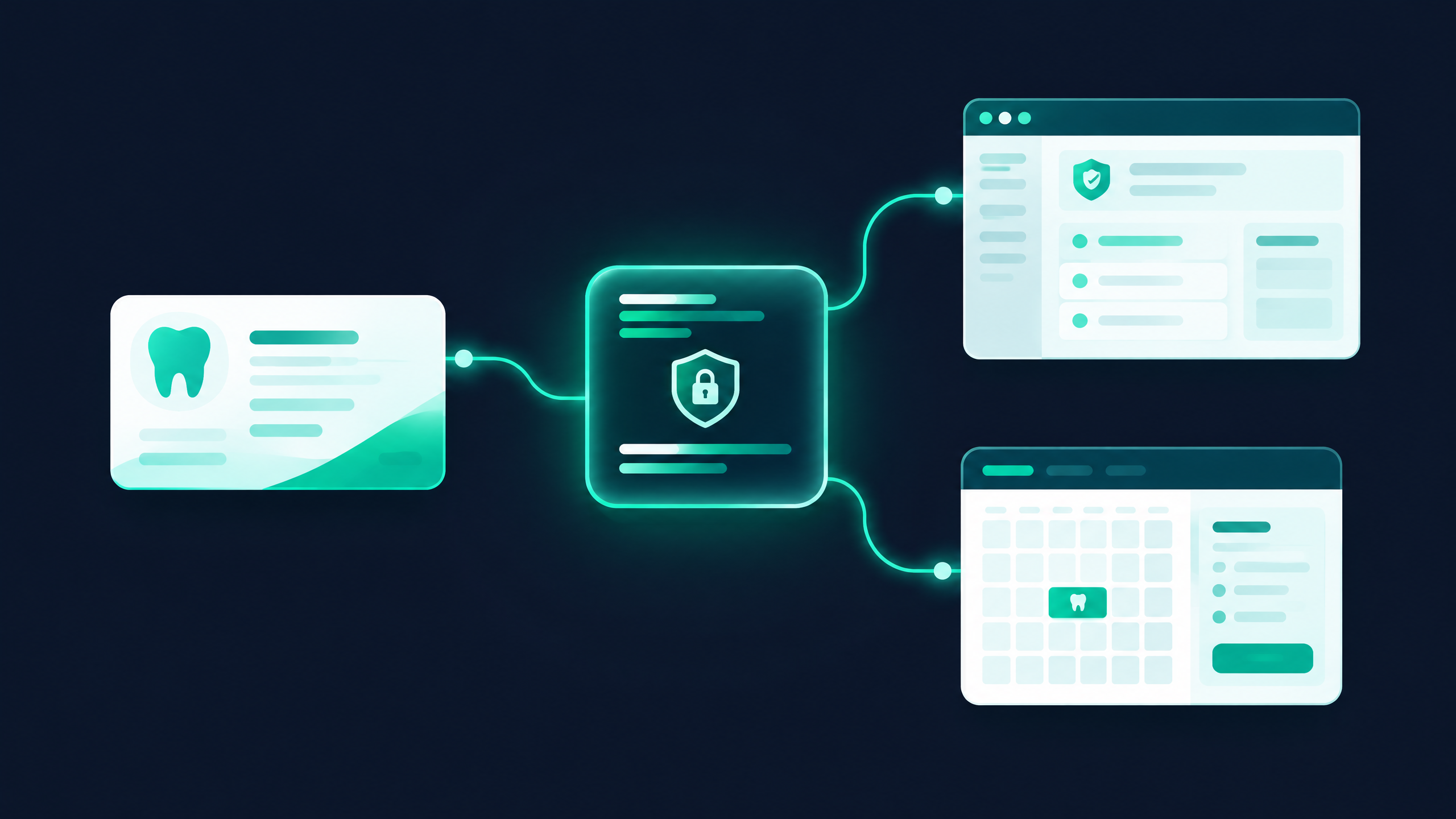
AI dental insurance verification software can change how this work gets done. Instead of relying entirely on staff to navigate payer portals and manually document benefits, AI can automate supported workflow steps, retrieve available information, and write verified details into the PMS where the appropriate integration is supported.
This guide explains how AI insurance verification works, why traditional workflows create bottlenecks, and what dental organizations should consider when evaluating automation.
What is AI dental insurance verification software?
AI dental insurance verification software automates repetitive tasks involved in confirming a patient's insurance eligibility and benefits before an appointment.
Depending on the solution and payer, a workflow can include:
- Accessing supported insurance payer portals
- Locating patient insurance information
- Retrieving eligibility and benefit details
- Identifying relevant coverage information and limitations
- Recording verification results
- Updating the PMS through a supported workflow
Traditional verification often requires an employee to complete these steps manually. AI automation can perform supported steps in the background, allowing staff to focus on exceptions, patient communication, and other responsibilities that require human judgment.
For organizations managing multiple locations, automation can also help standardize verification processes across participating practices.
Why manual insurance verification becomes a bottleneck
Manual insurance verification involves more than checking whether a policy is active.
Repeated payer portal logins
Dental teams may work with many insurance carriers, each with its own portal, navigation, and information layout. Staff must repeatedly access these systems to retrieve the information needed for upcoming appointments.
Repetitive data collection
Eligibility, effective dates, deductibles, annual maximums, waiting periods, frequencies, and procedure-specific coverage may all need to be reviewed. The same steps must be repeated for each patient, creating a substantial administrative burden.
Information scattered across systems
Insurance details may be available through payer portals, eligibility responses, existing patient records, and other sources. Moving information between these sources and the PMS creates additional work and opportunities for documentation errors.
Last-minute verification
When verification falls behind schedule, staff may have to investigate benefits shortly before the appointment. That leaves less time to communicate coverage information, discuss financial expectations, and prepare for treatment.
Difficulty scaling across locations
For DSOs, each practice may have different staffing levels, appointment volumes, and established processes. Without a consistent workflow, maintaining visibility and verification standards across locations becomes more difficult.
How AI automates dental insurance verification
An automated verification workflow can move through several stages:
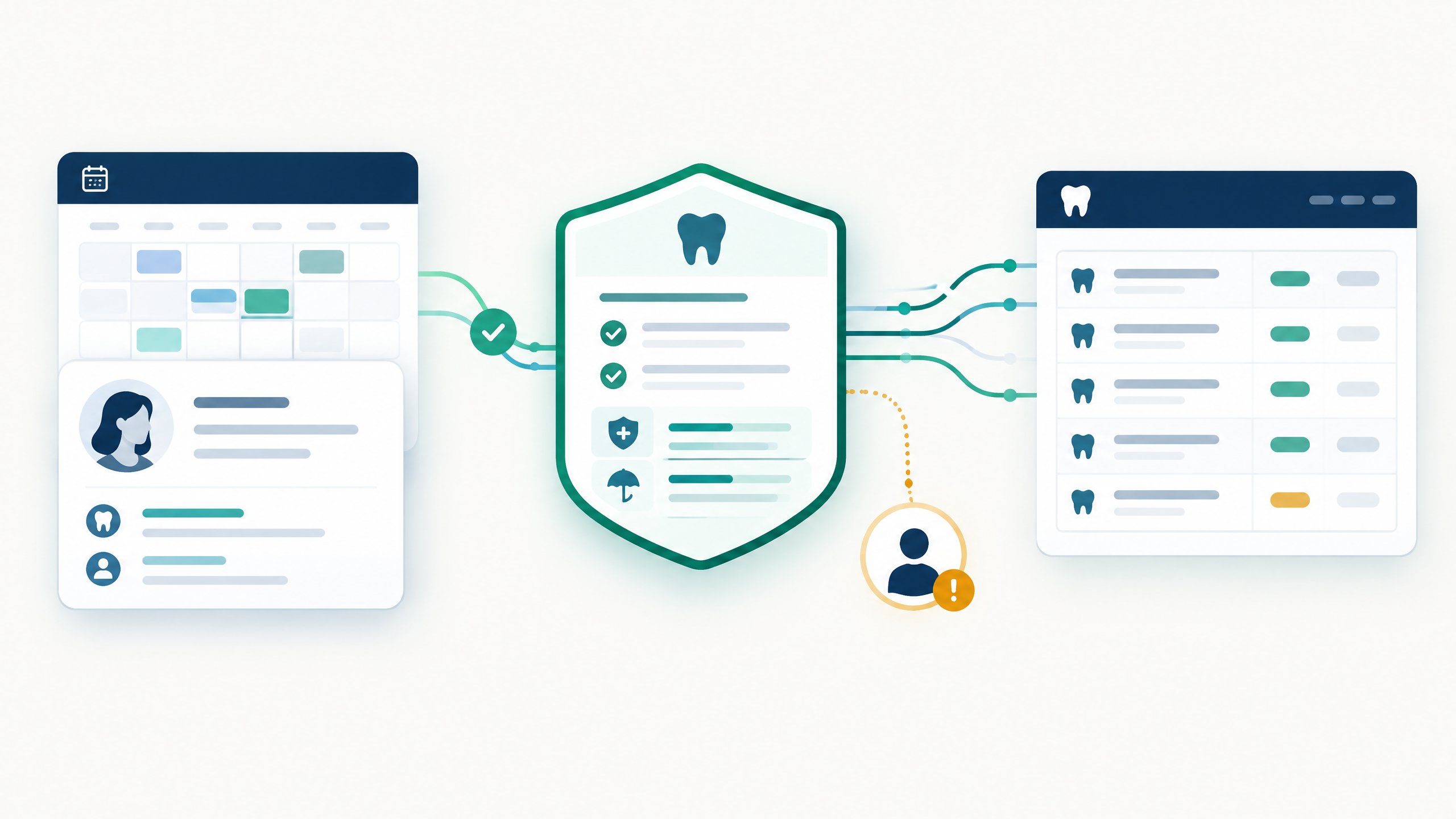
- Identify upcoming appointments. The workflow identifies patients who require insurance verification using the available appointment and patient information.
- Access supported payer portals. AI navigates supported payer portals to retrieve available eligibility and benefits information.
- Retrieve and organize benefits. The workflow collects relevant insurance information, subject to payer availability and the capabilities of the automation.
- Document results in the PMS. Where supported, verified information is written into the practice management system, reducing manual data entry.
- Surface exceptions for review. Unavailable information, discrepancies, and cases requiring additional judgment can be routed to the appropriate team.
The objective is to complete routine verification work before the appointment whenever possible, rather than leaving staff to manage every step manually during the workday.
How insurance verification fits into your dental PMS workflow
A practice management system is central to scheduling, patient records, treatment planning, and insurance administration. Automation is most useful when it complements established workflows instead of creating another disconnected process.
Dentrix insurance verification
Dental practices using Dentrix can evaluate how insurance verification automation fits their existing appointment-preparation and patient-record workflows. The goal is to reduce repetitive payer research and manual documentation while keeping relevant insurance information accessible to the team.
Eaglesoft insurance verification
For Eaglesoft users, the evaluation should focus on how verification results can move from supported payer sources into the practice's existing patient and insurance workflows. A suitable automation process should minimize duplicate entry and help staff identify cases that need attention.
WinOMS insurance verification
Organizations using WinOMS should assess how automated verification can fit their existing patient-management and insurance processes, including the supported method for retrieving and recording benefits.
Oryx insurance verification
Practices using Oryx should evaluate whether verification automation can work with their current scheduling, patient-information, and insurance-documentation processes without introducing unnecessary operational complexity.
Important: Confirm the exact PMS version, supported workflow, and integration method with Dentistry Automation before representing any of these systems as a confirmed, direct integration.
What information should dental insurance verification cover?
An effective verification process should collect the relevant information available for the patient's plan and planned treatment.
| Verification item | Why it matters |
|---|---|
| Eligibility status | Helps establish whether coverage is active |
| Effective dates | Identifies relevant policy dates |
| Deductible | Helps determine the patient's potential financial responsibility |
| Annual maximum | Shows the plan's applicable annual benefit limit |
| Coverage by procedure | Helps explain applicable benefits for planned treatment |
| Waiting periods | Identifies restrictions that may apply |
| Frequency limitations | Helps identify limits on covered services |
| Missing or conflicting information | Signals when further investigation may be needed |
Coverage information should be interpreted in context. Eligibility verification is not a guarantee of payment, and benefits can change or remain subject to payer review.
Benefits of AI insurance verification for DSOs
For multi-location dental organizations, automation can offer advantages beyond reducing manual work:
- More consistent workflows: Standardize routine verification processes across participating locations.
- Earlier preparation: Complete supported verification tasks before patients arrive.
- Less repetitive administrative work: Reduce time spent navigating portals and re-entering information.
- Improved operational visibility: Track verification completion and identify cases that need attention, where reporting is available.
- More time for patient-facing work: Allow staff to focus on financial conversations, scheduling, and exceptions.
- A scalable operating model: Support growth without relying exclusively on increasing manual verification capacity.
Actual results depend on appointment volume, payer access, integration capabilities, and existing processes.
What to look for in AI dental insurance verification software
Before choosing a solution, ask these questions:
- Which payer portals are supported?
- Can the system retrieve detailed benefits or only basic eligibility?
- Can results be written directly into our PMS?
- Which PMS products and versions are supported?
- How are incomplete verifications and conflicting data handled?
- Does the solution support overnight processing?
- How are access controls, auditability, and HIPAA obligations addressed?
- Can we monitor verification completion across multiple locations?
These questions help distinguish meaningful workflow automation from tools that simply display information or require staff to complete most of the work themselves.
Automate insurance verification before it becomes a bottleneck
Insurance verification is essential to preparing for patient visits, but it should not require your team to spend the day repeating the same portal-based tasks.
With AI-powered insurance verification, dental organizations can automate supported verification workflows, retrieve available benefits, and document results within their established systems. Dentrix, Eaglesoft, WinOMS, and Oryx users should evaluate how automation can fit their specific PMS environment and existing processes.
Review the Dentistry Automation insurance-verification workflow or explore the DA Verify developer API for an integration conversation.
Book a Demo with Dentistry Automation
Book a Demo with Dentistry Automation to discuss your current process and the capabilities that can be confirmed for your environment.
See the workflow
Dentistry Automation runs verification, payment posting, and claims workflows with AI, backed by people for the exceptions. See how it works.