Payment posting is often viewed as a downstream process. An insurance payment arrives, the supporting information is reviewed, and the transaction is posted to the practice management system. On the surface, it seems straightforward.
Yet many dental practices find themselves dealing with posting delays, reconciliation challenges, and increasing administrative workloads despite having experienced teams and established processes in place.
When these issues arise, the first assumption is often that the team needs more time, more resources, or a different workflow. While those factors can certainly influence performance, they are not always the root cause.
In many cases, payment posting challenges begin much earlier in the revenue cycle. The real issue lies in how information moves—or fails to move—between the systems that support the process.
When People Become the Integration Layer
Every payment posting workflow relies on information from multiple sources.
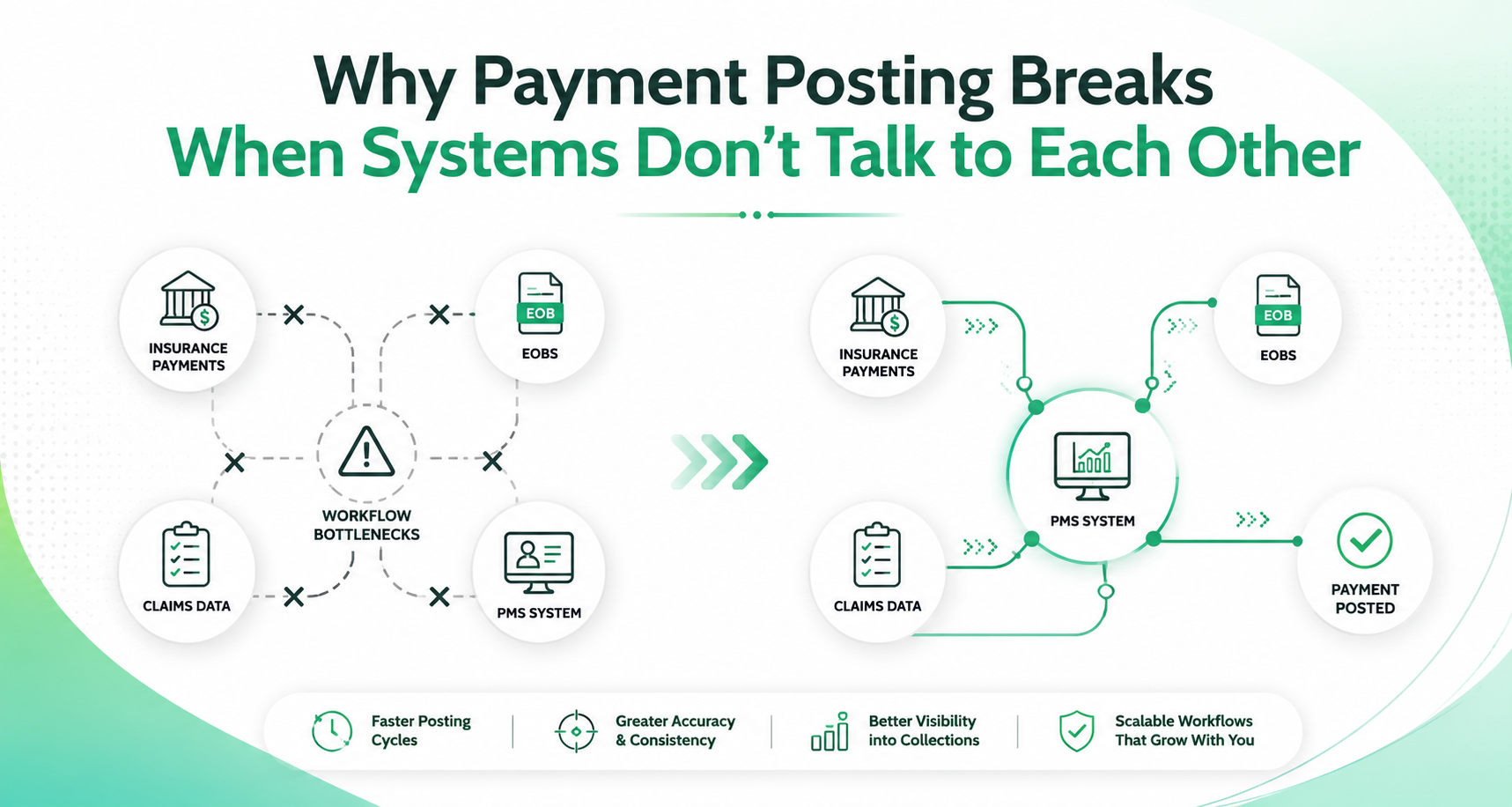
There are insurance payments to review, EOB details to verify, claim records to reference, patient account information to validate, and practice management system records to update. While each piece of information may be available, it is not always accessible in a single place.
As a result, team members often find themselves moving between portals, reports, spreadsheets, and PMS screens to gather the information needed to complete a posting accurately.
The challenge isn’t necessarily the complexity of the posting itself. The challenge is the effort required to connect the dots.
Over time, employees unintentionally become the integration layer between disconnected systems. Instead of information flowing seamlessly through the workflow, staff spend valuable time searching, comparing, validating, and manually transferring data from one source to another.
The process may still get completed, but it becomes heavily dependent on human effort to compensate for gaps in system connectivity.
Why Growth Makes the Problem Harder to Ignore
Disconnected workflows have a way of hiding in plain sight.
When payment volumes are relatively low, teams can often manage the additional effort required to reconcile information across multiple systems. Small inefficiencies are absorbed into the daily routine and may not appear significant.
As practices grow, however, those inefficiencies become increasingly difficult to ignore.
More payments mean more records to review. More claims mean more opportunities for mismatched information. More locations, providers, or insurance carriers create additional complexity that requires coordination across an even larger volume of data.
The result is a workflow that becomes progressively harder to scale.
Posting timelines begin to stretch. Administrative workloads increase. Reconciliation requires more effort. Financial visibility may be delayed because transactions have not yet been fully processed.
What once seemed like a staffing challenge often reveals itself as a workflow connectivity challenge.
Payment Posting Depends on More Than the Payment
One of the most common misconceptions about payment posting is that it starts when the payment arrives.
In reality, payment posting depends on a chain of information that begins much earlier. Every transaction is connected to claim submissions, insurance responses, patient records, procedure details, and the systems used to manage them.
When information moves smoothly between those systems, payment posting becomes significantly easier to manage. Teams spend less time gathering supporting data and more time reviewing and validating the information that matters.
When systems operate independently, however, every transaction requires additional effort to bridge the gaps.
This is why practices that focus exclusively on the posting process itself may struggle to achieve lasting improvements. Optimizing a single step in the workflow can only go so far if the information supporting that step remains fragmented.
Connected Systems Create Better Payment Posting Outcomes
Improving payment posting is not simply about increasing speed. It is about creating a workflow where information is available when and where it is needed.
Practices that invest in stronger PMS integration and more connected workflows often find that many of their payment posting challenges become easier to manage. Teams spend less time navigating between systems, manual handoffs are reduced, and information is easier to access throughout the process.
The result is greater consistency, improved operational visibility, and a workflow that can support growth without requiring a proportional increase in administrative effort.
Payment posting rarely breaks because people stop doing their jobs effectively. More often, it breaks because the systems supporting those people are not communicating as efficiently as they should.
As dental practices continue to grow and operational demands increase, the ability to create connected workflows will become just as important as the ability to process payments themselves. The practices that recognize this shift are often the ones best positioned to build more accurate, efficient, and scalable payment posting operations.