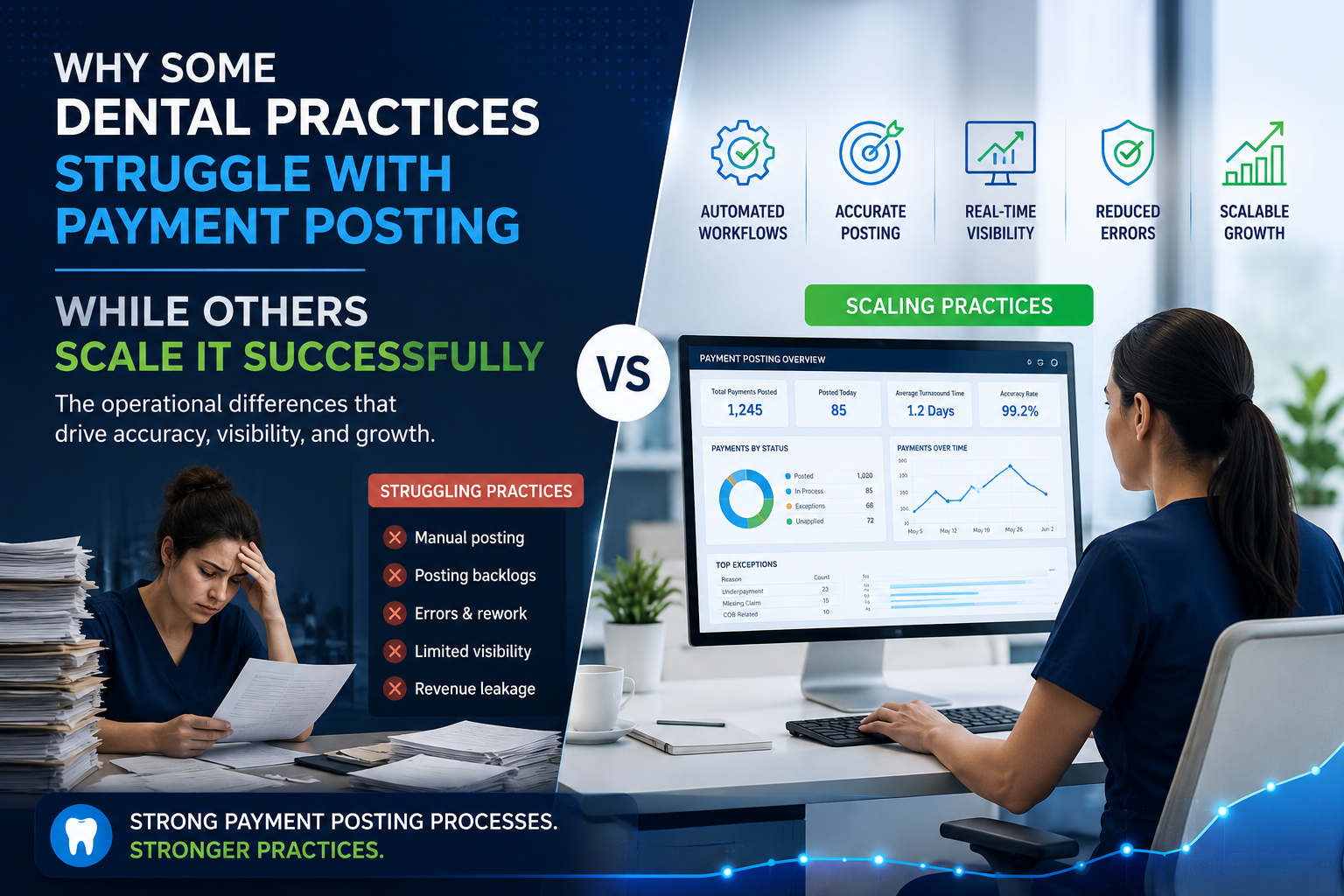
As dental practices grow, payment posting becomes increasingly difficult to manage.
More claims. More payers. More remittances. More locations.
Yet some practices continue to process payments efficiently while others find themselves dealing with backlogs, inconsistencies, and limited visibility into their revenue cycle.
The difference often isn’t the size of the organization.
It’s the strength of the payment posting process behind it.
Let’s explore what separates practices that struggle from those that successfully scale.
Growth Exposes Weak Processes
Many practices can manage payment posting effectively when claim volumes are relatively low.
As patient volume increases, however, manual processes begin to show their limitations.
Tasks that once took a few hours each week can quickly become daily operational challenges.
Common signs include:
- Growing posting backlogs
- Delayed reconciliation
- Increased posting errors
- Difficulty tracking underpayments
- Inconsistent reporting
Growth doesn’t create these problems, it reveals them.
Struggling Practices Rely on Individual Knowledge
In many organizations, payment posting depends heavily on the experience of specific team members.
Over time, employees develop personal methods for:
- Handling adjustments
- Processing write-offs
- Managing exceptions
- Reconciling payments
While this may work in the short term, it creates operational risk.
When processes live in people’s heads rather than documented workflows, consistency becomes difficult to maintain.
As teams expand, variations in how payments are posted can lead to reporting discrepancies and unnecessary rework.
Scalable Practices Build Standardized Workflows
Practices that scale successfully typically establish clear posting standards.
Rather than relying on individual preferences, they create consistent processes for:
- Payment application
- Adjustment handling
- Write-off management
- Exception resolution
- Reconciliation procedures
Standardization creates predictability -> Predictability creates accuracy -> And accuracy creates confidence in financial reporting.
Struggling Practices Spend Too Much Time on Routine Work
Manual payment posting often forces teams to spend valuable time on repetitive administrative tasks.
As payment volume grows, teams become occupied with:
- Reviewing remittances
- Entering payment details
- Matching payments to claims
- Updating ledgers
The result is a constant focus on transaction processing rather than problem solving.
Teams become busy but not necessarily productive.
Scalable Practices Focus on Exceptions
High-performing practices understand that not every payment requires the same level of attention.
Instead of manually handling every transaction, they focus resources where human judgment adds value.
Examples include:
- Underpayments
- Missing payments
- Complex adjustments
- Reconciliation discrepancies
Routine transactions follow standardized workflows, while staff focus on identifying and resolving issues that directly impact revenue.
This approach improves both efficiency and accuracy.
Struggling Practices Lack Visibility
One of the biggest challenges in payment posting is knowing when something goes wrong.
Many practices discover issues only after they begin affecting:
- A/R reports
- Financial statements
- Collections performance
- Patient balances
At that point, resolution becomes more complicated and time-consuming.
Without visibility, small issues often become larger operational problems.
Scalable Practices Prioritize Operational Visibility
Organizations that scale successfully understand that payment posting is more than a transactional process.
It is also a source of operational insight.
They monitor:
- Posting turnaround times
- Exception volumes
- Reconciliation status
- Underpayment trends
- Workflow bottlenecks
This visibility helps leadership identify issues early and make informed decisions before revenue is impacted.
Technology Becomes More Important as Complexity Increases
The larger the organization becomes, the more difficult it is to maintain consistency through manual processes alone.
Additional locations, payers, providers, and claims create complexity that can overwhelm traditional workflows.
This is why many growing practices and DSOs are exploring automation to support:
- Standardized posting
- Improved accuracy
- Faster processing
- Better visibility
- Scalable operations
The goal isn’t simply to reduce manual work.
It’s to build a payment posting process that can grow alongside the organization.
What Successful Organizations Understand
Practices that scale payment posting successfully share a common mindset.
They recognize that payment posting is not just an administrative task.
It is a critical operational function that influences:
- Revenue visibility
- Financial accuracy
- Team efficiency
- Growth readiness
By focusing on process consistency, visibility, and scalability, they create a stronger foundation for long-term success.
Conclusion
The gap between practices that struggle with payment posting and those that scale successfully is rarely about effort.
More often, it comes down to process maturity.
As practices grow, payment posting must evolve from a manual, transaction-focused activity into a standardized and scalable operational process.
Those that make this transition are better positioned to improve efficiency, maintain accuracy, and support sustainable growth.